Sunday, January 26, 2020
Sunday, January 14, 2018
Thankful for the Space to be Me
When the going gets tough, I like to sort, organize and thus firmly set my sights on moving forward positively -- or at least with my bed made and the filing done. So this week I made this chatterbox/fortune teller/fidget folder and I have started handing them out to the good spirits that surround us and even popped a couple in the mail. It has been so much fun think there might be more. Let me know if you have a mess or collection that you'd like help with.
|
Chatterbox One References and Notes – Clockwise from the gold star at
the top of the top left picture
|
|
|
|
Background is copy of a copy of a Tanzanian work permit
A picture of origami boxes with 2boys’ Shiny Turd
A clipping of jet silhouettes from the Canadian Aviation Museum’s floorplan
handout
Inspirational words on sticker imported from Taiwan by a company
called MultiCraft
Star stickers were imported from China by CTG Brands Inc.
|
|
|
A clipping from a picture of the National
Arts Centre in Ottawa from a Prelude programme produced by the NAC.
The sloppy mannaz rune was chosen to enhance relationships and was
inscribed in silver Sharpie
|
|
|
Background drawing of a shooting star and words by Boy2
Clipping of an inspirational quote from Einstein on a sticker in the
same packet from MultiCraft. Full quote on sticker: Learn from yesterday.
Live for today. Hope for tomorrow. According to The telegraph.co.uk he finished the
thought with:
The important thing is not to stop questioning.
Star stickers were imported from China by CTG Brands Inc.
|
|
|
Zimbabwe Ruins detail c.2004
The rune for “need” was inscribed in silver Sharpie but I’m glad it
doesn’t show up very well
|
|
|
Detail of a picture of a bridge from a card my
Dad send me in the mail in 2017
Words from Simon’s poem in the Republic of
Childhood
|
|
|
Zimbabwe Ruins detail c.2004
The rune for “dice cup” or “vulva” was inscribed in silver Sharpie
|
|
|
Background clipping from an airplane notebook my Mum gave us
Words from Simon’s poem in the Republic of Childhood and from my
business card
Star and sunglasses emoji stickers were imported from China by CTG
Brands Inc.
|
|
|
Clipping from a picture on an entry ticket to Canadian Museum of Nature
The rune for “torch” was inscribed in silver Sharpie
|
|
|
Bee picture shot at the Round House Dar es Salaam c.2010
Live for today is part of the quote from Einstein as explained above
|
|
|
Zimbabwe Ruins detail c.2004
The rune for “day” was inscribed in silver Sharpie for positive
outcomes
|
|
|
A copy of the cover of The Republic of Childhood – a chapbook of
poetry by the Fisher Park Summit Alternative Poetry Collective presented by
the Ottawa International Writers
Festival in November 2017
Hope for tomorrow is part of the quote from Einstein as explained
above
|
|
|
Monument where a road crosses the Tropic of Capricorn in South Africa
detail c.2004
The rune Raido for “journey or path” inscribed in silver Sharpie
|
|
|
Our Defender Puma near Lake Malawi c.2010
Words from Simon’s poem in Republic of Childhood
|
|
|
Monument where a road crosses the Tropic of Capricorn in South Africa
detail c.2004
The rune algiz for protection was inscribed in silver Sharpie
|
|
|
I clipped my husband out of a picture shot of him working on a job in
Dar es Salam then printed in a corporate magazine c.2009
He’s now flanked by a picture of a tower near Niagra Falls clipped
from a tourist picture we had taken as a family then printed on a shot of the
falls at night when we were there in 2014
The crest is on a plane displayed at the Canada Aviation and
Space Museum and was clipped from a Treasure Hunt handout 2boys enjoyed
working on there
Words from the header of page 2 of The Republic of Childhood
My cell and email coordinates
Star stickers were imported from China by CTG Brands Inc.
|
|
|
A clipping from a picture of the National Arts Center in Ottawa from
a Prelude programme produced by the NAC.
The rune yera was inscribed with silver Sharpie
|
Thursday, August 24, 2017
Ramblings of a Whenwe
About a month ago we were getting on a city bus with our backpacks, going out to the burbs to stay with my folks for a night or two when Boy B asked: “Mom, are we refugees?” “Nope, we’re economic migrants who are very lucky not to be living in the Jungle,” I replied to amused glances from a couple other riders. Either that or they were smiling with pity at 2boys for their mother’s ranting.
No more empty promises on regular posts. As ever, I am so very grateful for some real encouragement and support to properly make this a regular exercise. What’s different when you land in your hometown among old friends and family after more than 15years away? Everything and nothing. I’m keeping notes and digging through notebooks from a life that I left only 9weeks ago but it feels like a lifetime.
We’ve been moving since 01January this year and it is really good allow ourselves to settle in. We’re feeling very fortunate to have landed and moved very quickly into a comfortable house with an easygoing room mate. Having time to take time to get to know our neighbourhood and settle into housekeeping for ourselves is a blessing that is a challenge to put into practice but we’re getting there.
I had some business cards made up with this picture. The colour is a little washed out in print. The stone in the background is Ugandan granite. It is a grain grinding stone that DH picked up along the highway in Uganda on a route survey trip some years ago. The shell shaped object is called the Shiny Turd or something equally scatologically funny to 9 and 12yr olds. They made it by melting down their fishing weights in one of our last bonfires by the ocean in Dar es Salaam. They poured the molten metal into a shell – which may have been a smallish land snail shell BTW – and then when it had cooled, they broke the shell away. I folded up the boxes from animal print origami paper my sister gave me ages ago. They represent my empathy with every other human being trying to get and keep their shit together. Peace and love to all.
Monday, February 20, 2017


Such breathtaking views. 7adults and 8kids, the later are so spoiled from living beside the Indian Ocean that most of the grown ups completely tuned out their various complains of hunger, thirst, missing shoes, refusing to wear hats and we eventually all fell silent soaking it all in. It takes about 40minutes to get there.
Dhow sailing boats have been in these waters for at least a millennium and a half if not two. These two were “modernized” by the addition of a relatively small outboard motor but were otherwise traditionally built with all wood pulleys and fixtures. If we weren’t perched on the gunwales, we were sprawled on the tarp covering the fishing nets that were stowed in the bottom of the boats. We were promised that on one way they would hoist the sail which is a marvelous thing to experience. They didn’t in our boat this time but they did in the other on the way home.
These dhows were hired for us by the handyman and long term resident of the property where we now live. They came from the fishing village just up the coast. If I get to see them again, I will ask the crews how old the boats are and how they came by them. It could very well be that they have been handed down through generations. Their price for the day was more than reasonable, they knew and handled their boats as extensions of their own bodies and they were helpful and cheerful through challenging children and authorities.
DH has decided that next time he wants to go at night and have a bonfire party. I don’t know how he’s going to allow for the windiness of the place or the navigational challenge of getting home in the dark. He’s going to have to discuss that with the dhow captains. Even if the later are keen to do it, I might not be brave enough to go along.
And here we are Monday. As I write, a sunbird plays in the water thrown up by a sprinkler into a hibiscus bush. I just tried to sneak around to get a picture but I startled him away. I can hear the whistles and chatter of the alien but resident parrots. They’ve become neighbourhood mascots after it is suspected they’ve been abandoned and/or released by former residents of the neighbourhood. These ones are African Greys but I also know of a Ring Necked Parrot that was lost here by former residents of the very house we now occupy. That was years ago but it is not implausible that Timothy could still be around.
Happy Monday all.
Tuesday, May 31, 2011
It never rains but it pours
Today we're expecting to go collect two more jack russel terriers and a tank of fish from the home of a departing family. The power is of course unreliable and I've got a list of power dependent but silly little tasks that I'm trying to get through. Apparently the about to be adopted fish are getting used to it. The last time I saw them was months ago and there's a few quite big exotic looking ones...the kids will love them. We had to have a tanker truck deliver water that we're now ratioing because we don't know when the city might turn their supply on again. I'm trying to put together my application so I can practice my new qualification as a polygraph examiner in this country. DH is putting in his resignation at his present job having officially accepted another yesterday. A year's rent is due on the house tomorrow. My to do lists are full and spilling over into project notebooks...meanwhile almost 6yr old and I take advantage of a spark of interest and seriously discuss the use of "to" vs. "too" in daily English writing. Life is beautiful. This is a shot of a nyala buck that followed his harem through the grounds of the cottage we hired over Easter near Pretoria, South Africa.
Monday, November 29, 2010
It is so marvelous to be back on line. I found it much harder to be the light one wants to see in the world when we were on day two of a neighbourhood blackout. The challenges of a 2.5yr old with chicken pox and creative, appetizing meals for the family with the quickly spoiling contents of fridge and freezer were a little overwhelming. Thankfully I haven't plugged in the chest freezer so I don't have to fret over finding any decomposing puddles in there and hubby got the message fairly quickly that a lunch out with Daddy on Sunday and a let Mom get some quiet time alone arrangement was in everyone's best interests.
Apparently the power company is stepping up its power rationing schedule. Usually they only turn off the power for a few manageable hours at a time. Two days seemed rather unfair from this side but there was also talk of a broken something or other. Transformers and cable are often poached in these parts. Given the lack of power for things like the computer and hot water for washing dishes I have had the opportunity to be outside more..or at least think away from the computer screen. Here's the latest of my garden safari. This fly is about half the size of my smallest fingernail. It hid behind the leaf and actually popped back and forth seemingly curious about the monstrous lens I poked into the bush right up to the edge of its leaf. Fond thoughts to all….must post and get off line -- I'm back on emergency back up power which gives me enough time to finish up, sign off and shut down. Pray for a short one!
Wednesday, September 29, 2010
Africa is Not for Sissies
It's dragons in the garden and road trips from Hell and it is battles of elemental proportions. It is two weeks since we flew home from our last road trip and the Landy is still standing in Mombassa without a functioning transmission. You know that you've had an extreme road trip when you manage to break a Defender. Ngorongoro was as marvelous as always and we made it through Tsavo for the first time which was incredible. Thankfully Kobus and I have managed to find two working power points in the kitchen so we can make ice and fire up the kettle at the same time. Here's a recent shot of a dragon-like caterpillar in our garden.
Thursday, May 06, 2010
Dinner company in Botswana
Our first night on the road was only about 1/2 the distance that we planned for from our starting point . After a hectic week in Pretoria organizing our new kit we set out for what turned out to be half a day in Mookgophong/Naboomspruit where we had 2 nifty 25litre water tanks fitted to the trailer.
Given that it was our first day and we were anxious to be driving anyway we drove around town for quite a bit…found the farmer's co-op, a bit of track to let the Landy get some mud on her... I learned that "Naboom" is the Afrikaans word for the Euphorbia tree. It was a quiet farming town that happens to boast a trailer factory.
We listened to several radio stations poking serious fun at pretty hostile political tensions and full on tantrums by important political personalities that had happened over the week we were there. These followed the murder of an elderly right wing leader by two young men who really might not have had a clue how his murder might be politicized. It made for riveting radio which we lost as we approached the Botswana border.
This Canadian was glad to cross the Limpopo River border into quiet, business-like Botswana. We hired a chalet at a lodge that overlooks the river and had a relaxing dinner on a lantern lit kondi/deck.
It was the night of the flying ants when an entire colony will reach the point in their lifecycle where they grow wings. They fly for about a day until you find them or just their wings by the hundreds and thousands caught in whatever puddles and condensation that can be found. They were attracted to the lights and our dinners and we picked quite a few out of our plates.
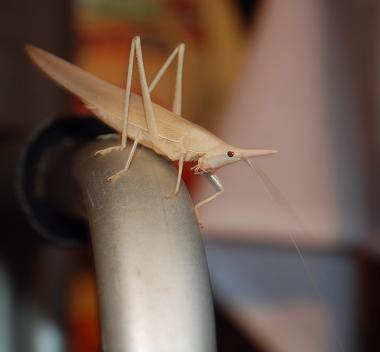
It is amazing what one attempts to suffer lightly in the hope that the kids won't freak out. I picked this grasshopper shaped creature off my head when it landed there, plopped it down on the floor and then took it's picture when it started climbing back up my chair. I don't think I would have been capable of that 10years ago...
Tuesday, April 27, 2010
Adventures in Africa: Overland from Pretoria to Dar es Salaam in 10..er..11 days
Some thought we were brave, others insane but we made it back to tell the tale. We drove the newest member of our family (see pic) some 4417km from Pretoria, South Africa through Botswana, Zambia, Malawi and then Tanzania home to Dar es Salaam. I rekon it was a huge success. I still love my husband and we didn't loose or otherwise leave either child behind anywhere. We had some absolutely fabulous moments along the way. Stay tuned for some more anecdotes and pictures as time and inspiration allow.
Wednesday, January 27, 2010
Garden Safari V: We Love our Lizards
Here in Dar es Salaam, we have an unusual one called a "Dull-green Day Geko." According to our reptile field guide this species is highly particular to this bit of coastline on the African mainland and to the Zanzibar Archipelago as well as being known to assist with housekeeping when they take up residence with humans. Apparently our gekos are listed in Appendix II of CITES due to their popularity with lizard collectors around the world. Despite frequent discoveries of small clutches of 2-3 eggs and their tiny former occupants, I have no intention of attempting to harness their impressive reproductory powers for profit. I just like watching them in what they assume is their natural habitat. They'll be here long after I am.
These rarer versions of the common house gekos we've lived with in all our African abodes are no more or less interesting and fun to have around. All the rooms in our house have their highly territorial geko occupants. The best way to keep track of who's who is to note the re-growth of tails lost in battles and other crises in lizard life. There are two males and a female in our living room engaged in a violent love triangle. The fights and dances are fabulous. Below is a picture of one day's victor and his lady -- ahem.
Wednesday, September 30, 2009
Home and Garden Safari IV: Leaf Bug
I love the tropics. Even though we live in the city now, there are still interesting creatures that visit our home and garden. The other night I was rummaging in the pantry for something or other and came across this beautiful monster. It is a "True Leaf Katydid" according to our bug book. It has cousins who's legs aren't quite so beautifully coloured that are just called "Leaf Katydid." I'm tickled to have met a "true" one.
I never came across bugs that were quite so substantial until I came to Africa. I am quite proud of myself for wrangling this one into the kids' "bug barn" so I could show it to Simon in the morning. I used a broom and a plastic tub that feta cheese came in. Kobus scoffed and suggested that grabbing it in my hand would have been quite easy: "It's just a big grasshopper." He grew up here... Anyway, Simon was less impressed than I had hoped but the poor bug didn't look nearly as impressive as it pressed itself into a corner of the cage. It was easily as long as my palm and quite fat.
The plan was to keep it overnight and then release it into the garden and take some pictures. I did just that. The movement of the bug's antennae as it slowly made his way out of the box onto the shrubbery showed it was obviously pleased to be released. The book says that they eat leaves and I don't know how long it occupied my pantry but there really wasn't anything in there that might keep it properly fed. Thankfully it didn't disappear so quickly and I could get a couple shots off. I left it there and had a look in the general area again a few hours later. Of course there was no trace of it passing but a happy memory of such a beautiful creature.
Friday, August 07, 2009
Power Politics
We've been running on generator power since then. Kobus drags himself down the two flights of stairs to the behemoth when he's having his first smoke in the morning. He starts it up and it rumbles and vibrates through the entire building through the day and into the evening powering the offices downstairs and most of our flat on top at a cost of about C$60/day. Of course we're thankful for the light, computers , A/C and the tv but unfortunately (for reasons that might have to be the subject of another post) the stove is not on the circuit connected to the generator. So we've been camping in the kitchen for a week, using a gas cylinder with a burner screwed into it. One pot dinners get a little tired after a few days.
So today after interminable runaround with the police who need to be well paid for the necessary report to the power company, the later came up with two quotes handwritten on a couple pages torn from an exercise book. The first quote was for "official" service and the lesser quote was for "unofficial" service. There is little information available on the added value of the official service beyond paying twice the price as the work is done by the same people with the same equipment. I suppose there would be little in the way of reciepts for the cash handed over which would be a problem on company expenses.
Because the international company Kobus works for requires something a little more official looking, even in terms of quotations for service, the envoy was sent back to request same...which brings us to mid-afternoon friday and a better than average chance that we're in for another weekend of generator power.
I think that we'll have to take ourselves to the beach on Sunday.
Tuesday, August 04, 2009
On Angels' Wings
Wednesday, October 31, 2007
Garden Safari III: Kobus Rescues a Genet Baby
With the dog safely locked in our kitchen, we went outside to survey the situation. The little one was still staggering around the spot where it was first seen. Kobus then explained that he had heard it drop from the roof overhang outside. At first he thought it was one of the healthy population of bats that live in our roof but when he had a look he was surprised to discover the baby. The poor thing had fallen through a weak spot in the material that closes off the underside of the roof. There was a piece of rotted ceiling lying near the baby. I didn’t need to be asked twice to go and fetch my camera.
I handed Kobus a couple rags to protect his hands and he scooped up the little animal to see if there was any damage from its fall. It appeared to be unhurt and very docile in Kobus’ hands. It quickly moved from abject terror to only slight discomfort at this unusual turn of events in its short experience. In fact Kobus felt confident enough to let Simon touch and handle the beautiful little creature as well.
We know that at least one Small-spotted Genet (Genetta genetta) lives in our roof because we see her quite regularly sitting in the open among the shrubbery that grows on the roof and in a big tree that overhangs the roof. We’ve also seen her bounding through the garden and showing us how dexterous she is in climbing trees. The dog sits lookout for her every evening but in our own observation of her habits we’ve discovered that she’s quite aware that the dog is there and is adept at avoiding the dog’s gaze.
Genets are one of several smaller wild cats of
As our hearts warred with our minds, Simon and I held on to the little creature while Kobus climbed up to see if he could find a spot to safely put him back in the roof. Simon was obviously quite impressed with the genet baby and we were pleased with how gently he handled it. At not quite two and a half years old he has had some very interesting experiences with African wildlife.
Satisfied that he could attempt to release the baby into a spot where the roof was solid enough to hold it, Kobus took the baby from us and put him back up in the roof. We didn’t hear anything further and we haven’t found any tell-tale remains that would have indicated a less than happy ending to the night’s adventure. So we’re feeling somewhat confident that the baby found its way back to its litter mates and its mother came home none the wiser about the strange smells her baby picked up while she was out. It would be nice to be able to say that we’re 100% sure of that but all we can say is that we did the best we could and that we’re all very happy to have the memory of coming so close to such a beautiful creature that shares our home with us.
Friday, July 13, 2007
Home and Garden Safari II – Snakes!
The Puff Adder (Bitis arietans) is
On Tuesday I was called to the house when I was out running some errands. I returned as quickly as possible having understood that there was a big snake in the house. Thankfully, as I got out of the vehicle I found the gardener, the guard and the maid near the fire place in the back yard. Babu, our gardener was standing over a large specimen of the above mentioned puff adder, see picture also above. I recognized it instantly. She was curled up on herself and not in an aggressive posture. Babu was patting her gently with the stiff broom he uses as a rake. The guard and the maid were not nearly as calm as the old gardener but that is to be expected. Babu was in no rush. He asked me to go and get my camera. Below is a picture of him with the enormous puff adder he caught in our garden last year.
Babu is the KiSwahili word for Grandfather. We call him that because he is an old man which is unusual in this area and deserves respect anywhere. We employ Babu full time as a gardener although due to his advanced age, we don’t expect much in the way of labour from him. Babu has a skill set that is much more valuable to us than his experience in lawn and garden care for muzungu types. He is an expert in handling snakes. Apparently he comes from the local clan that is famous as traditional snake dancers and handlers. His services are sought by all on the mine when a snake moves too close for comfort. He captures them and is rewarded for his efforts in the form of a set fee per snake. He then releases each animal safely into the deeper bush surrounding the mine. Babu also is called upon when people suffer snake bite. He uses traditional medicine techniques to treat and apparently heal victims[1].
[1] Babu has spoken to me at length on the preparation and use of this traditional medicine. I have written a paper on this with some anecdotal evidence of his medicines at work which can be made available to interested readers.
So, I ran into the house, collected my camera and returned to the garden to get some pictures of the most recent specimen. Puff adders are terribly beautiful. They have a very distinctive and odd shape, as the picture above demonstrates. This shape makes them move in a deceptively sluggish looking manner. The snake escaped Babu briefly during our photo session and tried to hide herself in some ground cover in a flower bed. She was brought under control more quickly than I could swallow my heart again. Once Babu had the snake’s head safely clamped in one of his confident hands (see picture left), he encouraged me to touch the snake. Their scales are described scientifically as small, overlapping and strongly keeled[1]. Her pale, wide belly scales were surprisingly leathery and tough yet extremely smooth. Those keeled scales on her back felt like organic armour. Truly an amazing thing.
[1] Paraphrased from Spawls et al. “A Field Guide t the Reptiles of East Africa” A & C Black, London 2004 edition
Babu put the snake in a cardboard box and tied it with a length of bicycle tyre bungee. We then placed the snake on the back seat of the car and drove away to find the mine’s safety and health officer in charge of relocation of dangerous snakes. Mr.Kapemba accompanies Babu into the deep bush that covers the mine lease area and they release the snakes together. I can not find the words to adequately describe my feelings as I drove around the town with such a dangerous snake in a box on the backseat. Both Babu and I frequently looked over our shoulders to assure ourselves of the closed box flaps. We didn’t find Mr.Kapemba at his office but thankfully his truck was parked outside the town’s tree nursery and we did find him there. The snake was dumped out of the box onto the warm concrete road for the nursery workers to have a good look and for a final photo session. Then Babu put her back in the box for her trip into the bush with Mr.Kapemba.
Unfortunately, Babu has not always been present when dangerous snakes have appeared in our garden. Thankfully, Kobus is capable of taking matters into his own hands. Simon, Kobus and I were playing outside one weekend afternoon when the guard came running. Thinking it was another relatively slow moving puff adder we all approached the spot he indicated to have a look. I didn’t see it at that point but Kobus spotted it and quickly ordered me to take Simon and the dog inside. We had a large cobra resident. It was startled into retreating into the drainage culvert that runs underneath the end of our driveway. We have no idea how long it may have been living there and preying on the abundant bird species in our yard before it was spotted. The guard explained that when he saw it, it was stalking birds.
Kobus and the guard struggled with that snake for about an hour. They built a toxic fire at one end of the culvert to force it out. The snake wasn’t having anything to do with that. It hunkered down until the fire and its suffocating smoke was just too much. Finally it started approaching the other end of the culvert.
The snake would stick its head out of the culvert and, correctly assessing the danger of exiting, would retreat. Eventually, knowing that the snake was close to the end of the culvert, Kobus stuck the guard’s shotgun into the culvert and fired. The wounded snake finally left the culvert at which point Kobus decided that it was mortally wounded and safe enough for me to come out of the house and take some pictures from a distance. In the picture on the left Kobus holds the then headless carcass up against himself to measure the considerable length of the animal. Kobus is over six feet tall. While it is unfortunate that this mature snake lost its life, we can’t let such a dangerous snake live in our garden. Mwadui is notorious for its large healthy populations of puff adders and cobras.
We are living with a family of non-venomous snakes that we started to discover a couple weeks ago. We have a lovely screened in porch on the back of our house that serves as our living and dining room. It has double doors that open on the garden. Upon opening one of these doors early one morning, Kobus had a small snake fall on him and slither into a crack between the concrete slab of the house and the step into the garden. A few days later, he caught an identical little snake in the same place and released it into the bush at the back of our garden. On Monday of this week, another little snake appeared in the same place and he caught it and put it in a jar. We kept it in the jar for a day which allowed me to take some pictures and identify it as a White-lipped snake (Crotaphopeltis hotamboeia). The presence of the little snakes in our doorway made good sense as they eat frogs. We’ve had as many as 20 frogs, no bigger than 2.5cm long lining the doorframe on any given morning for the last couple months. However, there had been a sharp decline in their population for a few weeks and now we knew why.
It seems that this time of year is when the snakes that share our environment make themselves seen. Most of our snake sightings have been between June and August in the little more than a year that we have lived in this location. They are probably on the move looking for water and warm places to sun themselves. I am very grateful to Babu for his ongoing vigilance in safeguarding our family against dangerous snakes and I am also pleased that he has been able to remove them to places where they can carry on with their existence. I think it is best when we can all go about our business out of each others’ way.
Wednesday, March 07, 2007
Tanzanian Tales V: Home & Garden Safari I
Home and Garden Safari I
“Safari” is a KiSwahili word meaning “to travel.” When you are about to embark on a journey people wish you “safari njema” meaning “travel well or safely.” When you return from your journey people ask “habari safari?” which literally translates as “what is the news from your journey?” The polite answer to this is “mazuri
When we go on a safari as it is more widely understood, we generally travel into a protected African wilderness. Upon entry into these wilderness areas, we are given or buy or find in the guidebooks that have brought us to these places, a list of the birds, animals, bugs, reptiles and even sometimes plants and rocks that the wilderness area provides homes for. As tourists we find ourselves scanning these lists and ticking off the birds and animals we see. Sometimes we mark with a star those that we enjoyed the most or got good pictures of. I find myself wondering what the African guides who first saw tourists frantically ticking away thought of our headlong antics. Of course by the time I’ve visited any of these areas, the guides (when we’ve used their services) have been well used to our ways and have consulted the lists themselves in planning and prioritizing where to take us to make sure we got to tick as many as possible – thereby maximizing their tips.
Having spent my formative years in a Northern Hemisphere climate where winter has a significant limiting effect on the lengths to which life can grow, I consider the adventure of housekeeping in the Tropics a journey in discovery and wonder at the amazing variety and size that life can take. From a North American perspective, when
All this is to explain the inspiration behind what will hopefully become a series of pictures and words. Since I’ve been living and working in African countries, I’ve been collecting pictures of the plants, animals, bugs and birds that populate my home and garden. That is not to say that our homes and gardens in wintery places are not also places full of wonder and discovery. However, the sheer abundance and tenacity of life inside and outside my homes in
Eye spitter beetles are aptly named because they can secrete and even propel a noxious smelling acidic liquid when they feel threatened. They are member of the carabidae family of insect order coleoptera and can grow to and impressive 6cm long. The one in this picture had obviously seen a few fights given the damage on its shell near the end. Its body was about 5cm long. It may or may not have been the one who met its end in the following excerpt from my journal. The picture was taken in our bathroom a couple nights before the journal entry. Eulogy to the eye spitter beetle that died sometime today. Last night around this time I was getting ready for bed and discovered, to my horror, a largish specimen of the so called eye spitter beetle hanging on the net over Kobus’ pillow. Given that Kobus was home, I delegated the task of this potentially messy eviction to him. Kobus turned on the naked bulb that serves as the overhead light in our bedroom and chased the monster under the bed. The light, combined with our debate over weather the job was done briefly woke Simon. Reckoning the bug “lost” Kobus adjourned back to the couch while I managed to send Simon quickly back to sleep with some gentle words and a soothing touch.
Saturday, April 08, 2006
Croc Hunting in Senga Bay Episode #1
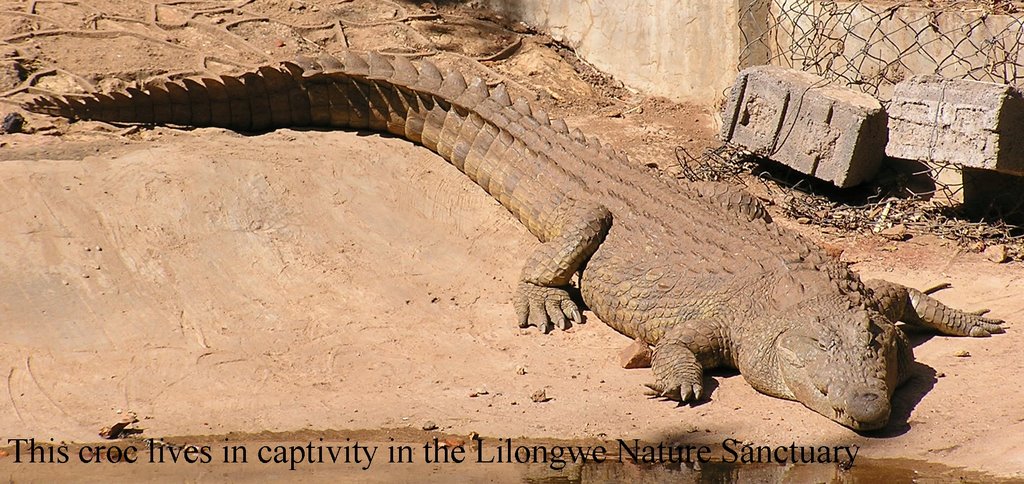
As an endangered species, there aren’t too many places in the world where crocodiles can be legally hunted. Malawi is one of those places due to its large stretch of lakeshore that is densely populated with both crocs and people. As a signatory of the Convention on the International Trade of Endangered Species (CITES), Malawi issues 20 highly sought after licenses annually. These licenses split the lakeshore of Malawi’s great lake into roughly even concessions where hunters can collect 20 crocs each. The hunters are issued with CITES tags for their trophies which allow them to trade the skins of the beasts they kill on the international market.
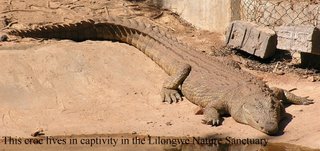
Internationally, crocodile skin can command fairly high prices although most of the skins that feed the world’s demand for purses, shoes, wallets and belts come from croc farms. Only the skin of the crocodile’s belly is harvested and traded. The skin is sold by the usable inch of flesh. In fact, wild crocodile skins are usually less valuable than their farmed cousins’ due to the latter’s regulated and sheltered lives and therefore less scarred bellies. Malawi has at least one croc farm that does a very lucrative business. Here, hunting crocodiles is considered a sport and a service to the rural communities that are saved from monsters that prey on people and livestock as well as compete with fishermen for sustenance. Hunting crocs is not a for profit exercise due to the expense of either hiring or owning and maintaining a boat that can take the hunter into croc territory and the low-ish odds of finding and killing a beast in the course of any given sortie.
This reporter’s short study has yielded the observation that writing on hunters and hunting comes in two distinct varieties with little or nothing in between. Hunters write about their successful hunts and the adventure, techniques and tools that led to success in their fields. Anti-hunting campaigners write about their disgust with the blood sport, the irresponsibility of (some) hunters and the danger to people and environments caused by hunters running around with guns, not to mention snares and other assorted traps. This is not the place to get into the debates on a global scale. It is a given that in any human undertaking there are those that go about it in an ill-informed, unprincipled, dangerous and/or selfish manner. It is also a given that human communities, especially rural ones, compete for space and resources with animals, their habits and habitats on a bloody day to day basis that leaves many urban citizens a little cold.
The experience of two recent weekends hunting has occasioned some interesting personal reflection on the debates. I hereby share the stories. I’ll put any growing queasiness to rest by stating now that no crocodiles died to bring you this story. A little known fact among non-hunters is that the odds are apparently about even that a hunter might discharge their gun in the direction of dangerous game on any given hunting sortie. Apparently, the appallingly low odds that something might actually be killed are an important motivator for otherwise comfort loving individuals to subject themselves to the discomforts and hazards of hunting big game.
Two weekends ago we were at the lake with the stated purpose of hunting crocs. Two friends joined us at our favourite lodge in Senga Bay about an hour’s drive from Lilongwe. They were hoping to join the expedition to root out monsters. Unfortunately, we didn’t even make it out on to the lake. Windy conditions throughout the weekend made the water too rough for accurate target acquisition from a boat. Instead, we visited a hippo and bird sanctuary and watched rugby on satellite TV.
So far so good. On the earlier hunting trip to the same lodge but with another couple, we did make it out onto calm night waters with two guns in the boat. I have learned of two methods of hunting crocodiles. If night hunting is ruled out as impossible, unsuccessful, or otherwise illegal, crocs are enticed into the rage of a hunter’s gun with the dripping remains of a recently killed animal hung over the water as bait. The hunter(s) wait under natural or duly constructed cover for their prey to investigate and feed on the bloody offering with obvious results. In Malawi, the accepted, less labour intensive and most popular method of croc murder is night hunting with a spotlight.
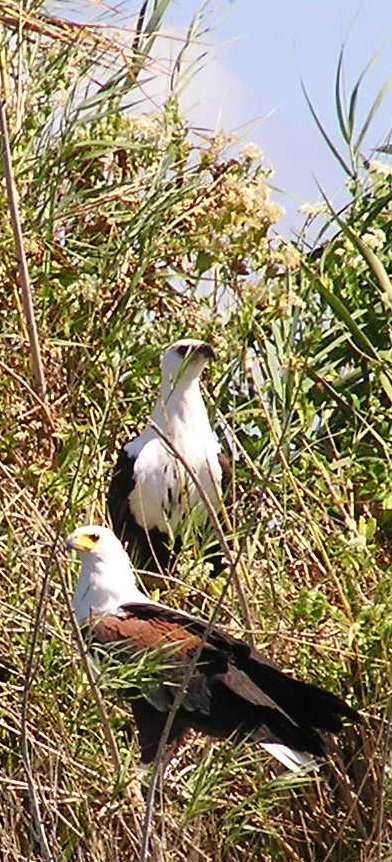
For the purposes of this expedition, the four of us headed out on the boat with a local guide during the day to scope out possible places where the beasts might be lurking. The guide took us into a strip of lakeshore where reeds and assorted water grasses formed a delta-like area of inlets and shallow waters. These form excellent fishing grounds for crocs and people alike. A short visit to a fishing camp revealed the information that indeed, there be monsters in those waters. One had killed a person only three months earlier. We spent some time motoring around the area, taking waypoints on a global positioning system unit and generally enjoying the beautiful environment. Apparently, the area used to be known for its phenomenal sport fishing. The sheer number of local fishermen on the water trolling for their living was ample evidence that this was probably no longer the case. The sight of the men standing in their dugouts swinging their circular nets over their heads like a lasso before flinging them into the water was picturesque if not encouraging. However, the profusion of water birds that prey on fish such as cormorants plus a beautiful pair of nesting fish eagles (pictured here) were a welcome sight. The clear water and warm sun enticed one hunter cum fisherman to try his hand with his fly fishing rod with no luck.

I returned with the hunters to the same spot well after dark. Having talked me into agreeing to be the “spotter” for their night’s hunting, they were able to dismiss the guide. I was reluctant to go due to the rough ride that we had had earlier and the other hunter’s wife’s refusal to accompany them. I did not have the excuse of pregnancy at my disposal and her encouragement that it was truly an adventure not to be missed won me over. It was a beautiful night. The water had calmed to a glassy surface that reflected the almost full moon beautifully. I learned to sweep the beam of light from the powerful spotlight across the surface of the water and to pick out the telltale red reflection from a crocodile’s eye hanging along the edge of the water where the grasses grew. Due to the need for activity by the hunter who was not the skipper of the boat, I was quickly demoted from spotlighter to gun bearer. In the end, I did not consider this a demotion given the challenges of trying to keep a loaded rifle out of the way of the hunters and the puddles in the boat while we quietly motored and drifted.
We spent the better part of two hours thus. We spotted, stalked and eventually came upon at least a dozen very young crocodiles that were all between 30-50cm in length. They were beautiful little things that were obviously too small to be considered fair game. It is amazing that their tiny eyes could be spotted and kept in our sights from at least a couple hundred meters. At one point, our companion hunter reached into the water and demonstrated beautiful croc capture technique, grabbing an unsuspecting creature just behind its head. We all marveled at its perfect little body and amazing strength as it thrashed in an effort to force its release. Of course it was released in due course and jack-knifed sharply as soon as the hunter let go in an attempt to snap at his hand in the air.
The larger size of the red dot combined with its distance from the comparative safety of the shore got the hunters really excited. The motor was cut and we drifted towards the beast. I tried to calm my panicked breathing as I quietly traded the gun for the light. The hunter steadied himself to shoot from the bow of the boat. I stood at his shoulder with the light, apprehensively wondering if the blast of the shotgun would knock me right into the water and if the thrashing of the beast would capsize us anyway. From my vantage, it was easily as long as the boat. We all saw and appreciated the size of the snout (and therefore the rest) of the monster before it dove and disappeared only to reappear as a distant red dot again before disappearing for good. We returned to the area several times, spotting the same beast and maybe a second smaller one from afar and coming within a few tens of meters each time but the bright moon was both a blessing and a curse as it lighted both our expedition and the beast’s escape.
As we quietly motored along the line of reeds where they met the water we were increasingly alarmed that most of this shoreline was covered by small gauge netting that hangs from the surface of the water to the shallow bottom about 1-3meters down. This is designed to catch everything that swims out of the reeds, including small crocodiles that keep to the edges of the reed beds for protection. This might explain the profusion of small crocs, the spotting of at least one and perhaps two monsters but nothing in between. This seeming unnaturally large generation gap can be explained by the admitted practice of the fishermen to kill small crocs that get caught in their nets thereby eliminating potential competitors before they become killers. It appears that the monsters have made their home there for some time but their attempts to reproduce are being frustrated by the fishing practices of the human communities in the area.
The fishermen complain of ever smaller catches in volume and size and quite obviously barely eke out an existence with their work. One might observe that state of the national highways and cost and availability of transport to move catches actually works in favour of the lake’s biodiversity but there’s no lack of piles of small fish in the cities’ markets. It appears that these methods are also much more effective in eliminating dangerous crocs from the lakeshore than the hunters’ expeditions will over the long term.

This is a shot of an average lakeshore fishing village in Senga Bay. Long tables are set up to dry fingerling fish that are a staple of many a Malawian’s diet. These houses sit on a small peninsula of land that is surrounded by water on three sides for most of the year. The dambo or swampy land in the foreground of this shot is occupied by cattle and hippos depending on how flooded it is. It is also prime crocodile habitat.
And so it appears that, along with most of the rest of the big game in Malawi, the crocodile is loosing ground (lakeshore habitat) to the pressures of a high population density living at subsistence levels. One wonders how long the government will find itself in the position to offer crocodile licenses. In the meantime, there is no lack of individuals who would be thrilled to be a part of the adventure weather they wield a gun or not. We’re in the process of sorting out how to offer people the chance to come along on an expedition whose time and space is fast coming to a close. I feel fortunate to have had the opportunity to feel the thrill of stalking one of the great beasts. It left me wondering who was at the greater advantage and I haven’t really been able to answer that question. I can say that I was much more pleased than the hunters to have left it to its business in safety, having proved its evolutionary superiority by outwitting three well equipped people in a boat with nothing more than the senses and strength it was born with.